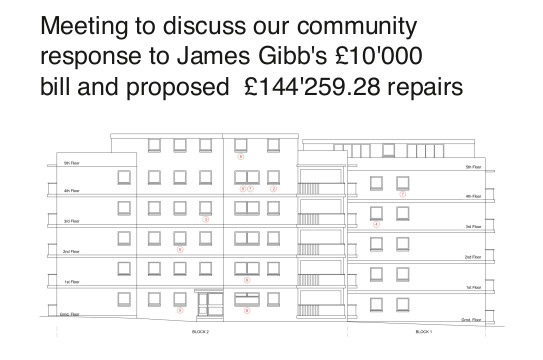
We are QPC Proud Meeting Wednesday 2nd October 7pm – 9pm Postal Bowling Club
We are QPC Proud Meeting Wednesday 2nd October 7pm – 9pm Postal Bowling Club
Present
Block 1
Annie Binks pp Mollie Binks – Flat 1 Dan Marshall (possible misspelling!) Flat 5 Phil Preston (PP) Flat 10 Jessica Brennan/Clare Randall Flat 12 Ben Hislop (BH) Flat 18
Block 2
Iris Gillies Flat 23 Ruth McLelland (RM) Flat 26 David Series Flat 31 Magnus Kidd/Imogen Tombling Flat 32 Joolz Flat 33 Betty Rodger Flat 34 Callum Ross Flat 35 Ann Chatham (AC) pp Douglas Chatham Flat 37 Stephen Goold (RCM) Flat 38 Ian Wood Flat 40 Rachel McCabe (minute-taker & RCM) Flat 41 Ken Boyter (KB) (RCM) Flat 42 Bill Young/Val Young (VY) (RCM) Flat 43 Brendan Bolland Flat 44
Contributors in absence
(Those who could not attend but left comments using the form) Jennifer Adamson Flat 24 Jennifer Neil Flat 44 Seonaid McDonald and James Lumsden Flat 30 Emma Brierley Flat 28 Neil Ramage Flat 36 Michael Flat 11
(RCM = Residents’ Committee Member) Introductions from the people chairing the meeting proved that between them they have experience in architecture, plumbing, heating, energy efficiency, mechanical engineering and industrial maintenance. The meeting itself involved table discussion on each of the points below and then ML would give each table a voice and the conclusions were minuted.
3 Basic questions that need to be discussed tonight:
- How was the bill for the survey authorised?
- What needs to be done to maintain our building in the long term?
- Is the proposed bill of £144,259.28 value for money for the 55 windowsills that need work done (26 of which are in urgent need of repair and 13 that should be replaced as a matter of urgency)?
How was the bill for the survey authorised?
The short answer to this is that it wasn’t. The original discussion was a major point of the AGM in January of this year (minutes available for whoever would like to revisit them) at which it was decided that there were two urgent issues for JG to address: the faulty electrical box on the ground floor of block 2 and the windowsill damage around both blocks. Committee Members confirmed that JG at no point told us how much the cost of the survey (both the Thomasons surveyor coming out to the building AND the tendering process) would be. It was noted that JG have offered to postpone 50% of £9,483.30, but JG propose that the full amount is due upon either completion or cancellation of the project.
Questions needing answering after this part of the discussion:
Is there a minimum amount above which JG cannot spend without putting out a vote to all residents to gain approval before the financial outlay? RMW: There supposedly is, but the exact numerical figure not known to residents. Where do we stand legally if we don’t agree to pay?
BH: Is there a case for seeking legal advice on the imposed cost of the survey? RMW: Possibly yes, but I think that that is something to discuss only after the present matter of contractual obligations with factor and scale of essential work is demystified to residents
Does the lack of a window sill automatically mean that there would be water ingress? RMW: There was an open discussion on whether not tending to windowsills would cause water ingress to the concrete floor slabs.
RMW: No, not automatically. But that does not invalidate the need to fix windowsills, because their primary function is to direct water away from the window cavity and entering the window dwelling space which an essential function to maintain the building’s integrity in the long term.
Conclusion after this discussion:
There was no warning that the bill would be this high and as a consequence residents feel that there has been a breach of trust with JG. RMW: JG are actually in breach of their contract with each individual resident.
What needs to be done to maintain our building in the long term?
AC: How is the building constructed? RMW: The building is a brick construction with cavity wall, divided by a reinforced concrete floor slabs that comprise each floor level. The concrete floor slab extends out to form each balcony. There is some form of external concrete render that clads the building.
Summary of how the building was built
RMW: When the blocks were built, the sills were cast by pouring a single length concrete mould with continuous piece of rebar. Individual sills were made by cutting this cast length into smaller lengths forming individual windowsills. The problem is the rebar therefore butts up against the end faces of each sill instead of being completely buried inside. When the sill is laid in place there is a path for frost to run along the rebar inside the sill, starting from the end gaps between the edge of the sill and the window. These are the so called ‘short sills’.
Examination of the Thomasons survey
RMW: When it comes to specific windowsill repairs, Thomasons have missed at least one windowsill on the south elevation of Block 2. The inspection was carried out by accessing 3 flats in block 1 and 5 flats in block 2. There’s no sense that windowsills (both upper and lower sides) could have been properly examined in my flat or the flat adjacent to my balcony. The inspection was predominantly carried out with a pair of binoculars. This seems to me to undermine the rigour of the inspection.
RM: There’s a whole column of windows adjacent to my flat that don’t appear in the survey document, and I have seen a crack in one of them.
RMW: Okay so that’s at least two sills not spotted by Thomasons.
RMW: Thomasons have nominated 55 windowsills to be replaced, which are in different categories of repair. Of those 55 sills Kenny, Rory, Robin and Johnny have identified (using Thomasons definitions) only 26 that are in the categories of: ‘hairline cracking’, ‘extensive linear cracking’ or ‘portions of sill missing’. This means that 29 are in the category of ‘short sill’ or even lower category.
VY: Lower category sills – these are sills that have moss on them or cosmetic (non-structural) conditions.
RMW: Again, using Thomasons’ definitions, of the 26 sills identified, about 16 are in ‘extensive linear cracking’ or ‘portions of sill missing’. These 16 should certainly be replaced, but that is 55 sills reduced to 16 – many less than the number that we have been quoted. This calls into question whether the proposed work is economical.
KB: Undamaged sills have been there for 60 years there’s no reason they won’t last longer.
RMW: For the ‘short sills’ that have been nominated by Thomasons to be replaced; the gaps are less than playing card width. I would use FIX-O-FLEX H to seal them. It is a marine grade polymer, that I use to seal the large concrete water tanks that I install all over the world, which has excellent properties:
• It fills and binds to concrete and complies with movement (e.g., due to expansion and contraction of surround material with temperature changes). • It has a broad temperature and chemical resistance. • It does not degrade under UV (sun) light. • It can be painted. • Is to waterproof that it can be applied underwater. • The application could be performed from withinside each flat and does not required scaffolding.
AC: Can this product be easily sourced?
RMW: Yes, it can we use it all the time. There are also building grade products like CT1 bond that nearly as good but cheaper.
RMW My preference would be for a contractor to carry this work out, instructed and employed by JG, not to be performed by individual residents.
PP: There is also a risk of needlessly damaging the damp proof membrane on windowsills when replacing more sills than necessary.
Overall, the feeling was that the survey itself is imperfect and that Thomasons have misjudged the number of sills needing replacement or repair and that some of those they maintain need work simply need the moss cleaned from them.
There has been an over specification for the work required and yet at the same time some of the windowsills are clearly dangerous and to fix them needs to be done but at a cost that provides value for money.
###Conclusion after this discussion: Without Thomasons giving us a breakdown of the cost, we have no idea what each sill costs to repair/replace and how much of this cost is simply the enabling work required (e.g. the scaffolding).
Therefore, those present said that they would like to approach Thomasons again, via JG, for quotes to be redone based on essential sills (16 to be confirmed) and sealing work to be done, completed with an itemised breakdown of the costs, without any further costs to residents.
Individuals present said that they would be happy to attempt the minor work of cleaning and filling any cracks themselves…but at least one person present thought that the sealing work should be done by a contractor and not us.
Is the proposed bill of £144,259.28 value for money for the 55 windowsills that need work done (26 of which are in urgent need of repair and 16 that should be replaced as a matter of urgency)?
All, but few present (see below), felt strongly that the work was not value for money.
BH: We don’t know. We ourselves are not construction experts, this is impossible to answer.
RMW: Very good point. We do not know the marginal cost of replacing a sill. It could be that the £144k, comprising a large portion of ‘enabling costs’, is dominated by the cost of, e.g., scaffolding, and cost of replacing a single sill is marginal. However, it is improbable for scaffolding to cost this much, so we need a better breakdown of the costs involved in this work and the exact sills that need to be replaced.
BH: It is important to say that the committee has no additional power or authority over the residents to make decisions on their behalf. The practical, and single, function of the committee is to chase JG on the work that they are failing to carry out.
Future steps
The minutes of this meeting are to be distributed to all flat owners. Those present want their email address to be collected as the method of communication to be informed of the next stages of the matter.
Those present are prepared to help protect windowsills as much as they can so if taking photos of every single one is required, we would be happy to do so (to JG and QPC committee via qpcresidents@yahoo.com) and also any filling work, and remedial work that might reduce the cost whilst still keeping the building safe.
There is a Residents’ Committee Meeting on Monday evening, could RCMs raise at this the desire for a meeting between JG, Thomasons and ALL residents, not just the RCMs?
Ken Boyter to count the windowsills left that have not been included in the survey.
The work cannot proceed without a collective agreement from the residents to which everyone buys in.
If, eventually, this work does go ahead, would it also be possible to see what other procedures could be done whilst the scaffolding is up such as balcony cleaning/fixing and general painting work? (Just minuting this so that we have a record of it being discussed!)
Contributions in absence
These are the comments made ahead of the meeting by those who could not attend. Due to technical difficulties these were not shared at the meeting. They should however be considered as contributions to the meeting and are therefore included in the minutes.
How was the bill for the survey authorised?
I don’t feel the residents committee should be able to authorise things that are going to cost £215 per flat. That is something which should have been put out to ballot. The committee do not speak for us all, and in my view, could be better at communicating with those of us not on the committee.
I am still in the dark as to how it was authorised. Who knew what and when. I would like more details.
We don’t think it’s worth spending time arguing about the original survey by Thomasons. This was paid for (£20.18) as part of invoice dated 21/2/24. We have been provided with a copy of the survey which illustrates the issues. However in future, no work like this should be instructed on the approval of the committee alone if it is likely to cost more than £20 per flat.
The actions which have taken place since then have been handled incorrectly and possibly illegally by James Gibb. The survey documents should have been sent out to every homeowner after it had been received, as we all paid for this work. At this stage James Gibb should have explained the next steps.
At the AGM of 22/1/24 19 out of 44 flats were represented. Therefore it was not correct process for this meeting to have made a decision which would incur substantial costs as there was no way that a majority of flats could have voted in favour.
James Gibb has no right to instruct Thomasons without first getting the permission of a majority of homeowners. They have gone against their own ‘Written Statement of Services’ and the Development Schedule for QPC which accompanies it. Section 2 of the latter states:
James Gibb Authority to Act for non emergency repairs is; The greater of £10 +VAT per property or £1000+VAT per development. By engaging Thomasons, James Gibb have incurred costs to everyone of £215 - way beyond the limit stated in their Authority to Act. And, if we proceed to get the work done as proposed it would be in the region of £121000 (+VAT) - or £2750 (+VAT) per flat. This cannot conceivably go ahead without each homeowner having had the opportunity to first agree to it.
We were never sent the fee proposal and the terms of business for the project management. KO did not have the authority to instruct work without first consulting homeowners. And the promised correspondence was never sent.
Suggested way forward: We all write to James Gibb immediately and state that we are not prepared to pay the Thomasons invoice of £9483.30 at this juncture as we were not given the opportunity to approve this expense prior to the work being instructed. This is a breach of James Gibb’s own Statement of Services.
It all feels very unnecessarily muddled to me and hard to get a clear picture of what has happened. Apologies for missing this evening’s meeting and thanks to those who have organised it, but I’m on the tail end of a virus so can’t make it. If I were there I’d be note taking to ensure there’s a documented clear time line of the events that Committee members sign off on, so that it can be circulated to everyone in the block ASAP after the meeting for clarity.
It is a crucial that we have an accurate understanding of the authorisation (whether we agree or disagree with what has happened) in order to move forwards and avoid situations like this arising in the future.
I think this is an important point as it should help to determine what our liabilities might be e.g. are we ‘obliged’ in any way to proceed with this work through the factor or can we simply disengage from the process and just pay for the survey? Do the qpc committee have a view on what the legal position is in terms of their engagement with the factor and the original request for this work to be carried out? I assume that the committee and or the factor can authorise some payments. Is there an amount that can be spent without everyone in the blocks being consulted?
What needs to be done to maintain our building?
As long as the building is safe then I’m happy. We need to figure out definitively if sills and balconies form part of the building or are owners own responsibility. I believe we need external cladding for insulation and preservation (it would make the blocks more attractive and potentially solve damp issues too) Apparently grants for this may be made available to private owners in next couple of years. Not sure without further discussion. Each individual household is responsible for upkeep of windowsills and balconies to ensure they don’t fall into disrepair. The exterior fabric of the building is a communal responsibility and we need to collectively consider it’s maintenance. I suspect there are potentially some significant works that will need to be carried out in the short to medium term e.g. garages, balconies (I notice a crack in one of them) etc. If the ‘window sill’ procurement is an example of how the factor would intend to carry out more significant works then I would be concerned about them being asked to do it. But, do we have enough people willing and able to volunteer to coordinate such things and how would the money be collected? It may be more sensible to get the factor to mange the processes in future but could we have a greater input to each stage so that we don’t end up in a similar situation again. I want a building that is well maintained. I am happy to delegate this to the committee and the factors and accept that they will do things differently from me. I would like to be consulted on some issues, particularly expensive works. I think we need to have collective responsibility for the maintenance and a way of obtaining agreement amongst all of us that doesn’t allow for long delays or individuals blocking essential work
Is the proposed £144’259.28 work value for money?
No. Over 3 grand per flat? Not reasonable. No mention of any sort of payment plan available…I don’t have 3-4 grand lying around and I’m sure I’m not the only one. I’d hope that any work carried out would include a discount for those of us on the ground floor, should we pay for scaffolding that’s not required for our properties? I’m just applying the same logic as the lift, we don’t pay for that because we don’t need/use it. I am shocked and I don’t understand how this can be justified. I would like to know more. Someone came and looked at our sills as part of the survey and said they are fine. So who is getting the diamond encrusted sills?! In all seriousness, I would like to know how we could find a way to get a realistic quote from a reputable company. No, it is not value for money. Absolutely not. It is not value for money. It would be interesting to know how much it cost for each of the sills that have already been replaced and see how that compares. Its a lot of money, I can’t tell you if its value for money. I would probably ask for competitive quotes if I was going to answer this question, or research other similar buildings that have had this work done. There must be a few in the UK.
Is a window sill the responsibility of a house hold or the block?
I don’t know. Looking for some clarification re this question!
I would have assumed household but I can see that these are sort of built in as part of the structure. I am willing to accept that and pay to preserve the building providing we are not being taken advantage of.
Not sure - we would probably need to get legal advice on this matter.
Having referred to our title deeds, which are legally binding and clearly state shared ownership of only the communal staircase windowsills, and no other sills in the block, I believe them to be the responsibility of a household, not the block.
I don’t know and would be willing to pay for the replacement of mine if required. However, the ones that have been replaced to date have mainly been charged collectively so I think it makes sense to continue on that basis.
The buildings maintenance is the blocks responsibility
##Do you have any concerns or questions relating to windowsills and building maintenance not covered by the above? NOTHING further should be authorised or carried out without ALL flat owners being balloted. ALL work should be put out to tender. Is it time for another new factor?
I would like to know if we can reject the work. 144k seems ludicrous.
A few notes/queries on the limits of authority of the QPC Residents Committee: What is the latest situation? Is there a constitution?
I (Seonaid) was on the residents committee from January 1997 till August 2002. At that time each block had a separate committee. For block 2 the Chair/ Committee had a right to authorise work of up to £20 per flat. This was to cover anything of a non- routine or emergency nature that came up between meetings, to save having to ask the factor to write to homeowners on every single occasion to get agreement beforehand - but there were financial limits set. Having this in place reduced the cost of factoring. If non routine work was needed to be done beyond these amounts, a meeting would be called to get majority agreement and the factor would then be asked to write to homeowners according to the decision of the homeowners to get it formally approved. If matters have changed in the intervening years there should have been a notification of this ie, a Residents Committee constitution which a majority of homeowners have agreed to.
We need clear transparent mechanisms and financial thresholds in place for how individual households / the committee / the factor raises maintenance issues and moves forwards with them.
In addition to this, the structure of the committee needs to be made clearer: How regularly does the committee meet? What are the committee’s responsibilities? What is the duration of individual committee membership? I am conscious that we have employed a number of factors over the last few years and frankly none of them have provided the service levels I would have expected. Having said that, I would be reluctant to move to another factor (if that is being considered).
How will any decisions be reached at the meeting? What authority does the meeting have?
What are the views of the qpc committee? (I appreciate they operate on a voluntary basis and we should be grateful for the work they do). no, sorry I cant make it
Rachel McCabe & Rory Mills-Williams: 07/10/24. Contributions in Absence added by Robin Leonard 16/10/24.